
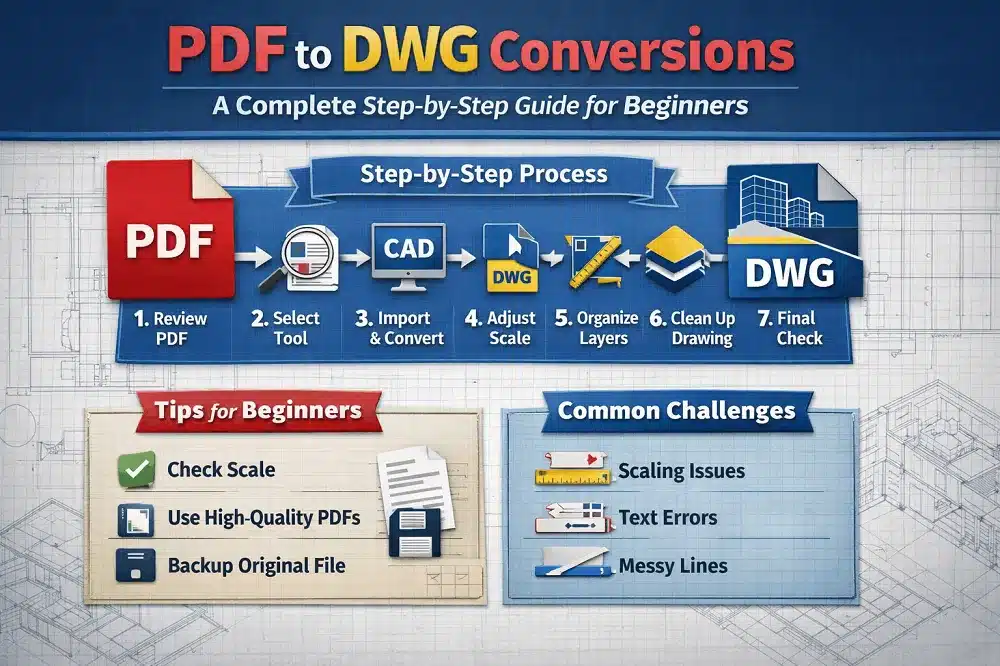
In today’s design and engineering workflows, drawings are often shared in PDF format because it’s easy to view, print, and distribute. Knowing how to convert PDF to DWG gets those drawings back into editable CAD. However, when you need to edit, modify, or reuse drawings, PDFs quickly become a limitation. This is where PDF to DWG conversions play a crucial role.
Whether you’re an architect, engineer, contractor, or CAD beginner, understanding how to convert PDF files into editable DWG format can save time, reduce rework, and improve accuracy. This beginner-friendly guide walks you through the entire PDF to DWG conversion process, tools, challenges, and best practices.
What is PDF to DWG conversion?
PDF to DWG conversion is the process of transforming a PDF drawing into a DWG file, which is the native format used by AutoCAD and other CAD software. Once converted, the drawing becomes fully editable, allowing users to modify dimensions and layouts, edit layers and annotations, reuse existing designs, and extract accurate CAD data.
PDF to DWG conversions are commonly used for legacy drawings, as-built plans, and scanned documents.
Why PDF to DWG conversion is important
- Editable drawings: Convert static PDFs into fully editable CAD files
- Cost efficiency: Avoid redrawing from scratch
- Accuracy improvement: Maintain scale and geometry
- Better collaboration: DWG files are easier to share and revise
- Time saving: Faster updates and revisions
Types of PDFs used for conversion
1. Vector-based PDFs
Created directly from CAD software, vector PDFs contain actual lines, arcs, and text objects. These are far easier and more accurate to convert — the geometry is already defined mathematically, so conversion tools can extract it cleanly.
2. Raster-based (scanned) PDFs
Created by scanning paper drawings, raster PDFs are essentially images. They require additional cleanup and tracing after conversion. Quality depends heavily on scan resolution — a 300 DPI scan will convert significantly better than a faded 72 DPI photocopy.
Step-by-step guide: PDF to DWG conversion for beginners
Step 1: Review the PDF file
Check drawing scale and clarity, identify layers, text, and dimensions, and determine whether the source is a scanned or vector-based PDF. This determines your tool choice and how much manual cleanup to expect.
Step 2: Choose the right conversion tool
Common options include AutoCAD’s built-in PDF import (PDFIMPORT command), online PDF to DWG converters, dedicated CAD conversion software, and professional conversion services. For beginners, AutoCAD’s built-in tools are a reliable starting point for vector PDFs.
Step 3: Import or convert the PDF
Open AutoCAD, use the PDFIMPORT command, select your PDF file, choose the relevant pages, and adjust import settings. For scanned PDFs, you’ll need a raster-to-vector tracing step first.
Step 4: Check scaling and units
Verify drawing units (mm, inches, metres) and use known reference dimensions to confirm the scale is correct before editing anything. Scaling errors caught early save significant rework later.
Step 5: Organise layers
Separate walls, dimensions, text, and symbols into named layers. Delete unnecessary elements. A well-layered DWG is far easier to work with and is expected by most engineering and architecture clients.
Step 6: Clean and edit the drawing
Remove duplicate lines, fix broken geometry, align misinterpreted elements, and convert exploded text back into editable text objects. This is the most time-consuming step for raster-source conversions.
Step 7: Final quality check
Verify dimensions against the original PDF, check alignment and accuracy, and save in the required DWG version for your client or project requirements.
Common challenges in PDF to DWG conversions
- Incorrect scaling after import
- Text converted as polylines instead of editable text
- Extra or broken lines from PDF compression artefacts
- Missing or incorrectly mapped layers
- Poor quality scanned PDFs producing unusable geometry
Best PDF to DWG conversion tips
- Always verify scale after conversion using a known dimension
- Use high-resolution PDFs (300 DPI minimum for scanned drawings)
- Clean the drawing before starting new edits
- Don’t over-trust auto-conversion tools — always manually review critical dimensions
- Keep a backup of the original PDF before making any edits
What is the best software for PDF to DWG conversion?
At ASTCAD, we recommend AutoCAD’s built-in PDF import for straightforward conversions, though it works best with simpler drawings. For more complex Australian construction or engineering projects involving multiple layers or precise specifications, we suggest dedicated conversion software or our professional conversion services. We’ve found that outsourcing to specialists like us ensures accuracy with local building standards and compliance requirements, saving you time and potential rework costs.
Can scanned PDFs be converted to DWG?
Yes, we can convert scanned PDFs to DWG, though the process requires additional work since scanned files are raster-based images rather than vector data. The accuracy of your conversion depends heavily on the original scan quality, and you’ll typically need to perform manual editing and cleanup to ensure the DWG file meets Australian building standards and complies with relevant engineering specifications. We recommend starting with high-resolution scans and allowing extra time for vectorization if precision is critical for your project.
Is PDF to DWG conversion 100% accurate?
No automatic conversion is 100% accurate, and we always recommend manual verification and editing to ensure precision. PDF files often contain embedded fonts, complex layering, or compressed data that don’t translate perfectly to DWG format, particularly with technical drawings common in Australian construction and engineering standards. We suggest reviewing converted files carefully and adjusting line weights, layers, and dimensions to meet your project requirements. Our team can assist with quality checking if needed.
How long does a PDF to DWG conversion take?
The conversion time depends on your file’s complexity and type. Simple vector PDFs typically convert in minutes, while complex drawings or scanned documents may take several hours. At ASTCAD, we recommend uploading your files during business hours so our team can prioritise them if needed. For urgent projects, contact us directly to discuss expedited processing options that suit Australian construction and engineering timelines.
Are online PDF to DWG converters safe to use?
We recommend caution with online PDF to DWG converters, especially for confidential architectural or engineering projects. While free online tools work for basic drawings, we advise using trusted desktop software or our professional conversion services for sensitive files containing intellectual property or client details. Australian firms handling building plans or technical drawings should prioritise data security and quality accuracy, which our specialist team can guarantee through secure, local processing.
What file version should I save the DWG in?
We recommend saving your DWG in AutoCAD 2010 or later versions, as these are widely supported across Australian design practices and construction teams. Check with your clients or consultants first, as some projects specify particular versions for compatibility. If you’re unsure, AutoCAD 2018 format offers excellent compatibility with most Australian firms while maintaining good file stability. Our team can assist if you need guidance on version selection for your specific project requirements.
Also useful: CAD Drawing — Complete Guide for Australian Engineers and Drafters | Fabrication Shop Drawing Checklist
Our team delivers accurate, standards-compliant drawings across all disciplines — fast turnaround, no obligation.