
Impact, shock and thermal loading on fibre optic splices.
Case study: impact, shock and thermal loading analysis on vertical fibre optic splices — ASTCAD performed multi-physics FEA to validate splice durability under combined loading.

Studying the effects of impact loading, shock loading and thermal loading on vertical fibre optic splice closure using FEA
Engineering Design & Drafting | CAE Services: CFD & FEA | Reverse Engineering | Rapid Prototyping | Product Design | Value Engineering | PLM Services | Technical Documentation
Case Study Highlights
Effects of impact loading, shock loading and thermal loading on vertical fibre optic splice closure using FEA
The Client
- Industry : Communication Products Manufacturer
The Objective:
- Evaluating vertical fibre optic splice closure for structural strength during impact loading, shock loading and thermal loading through finite element approach.
The Solution:
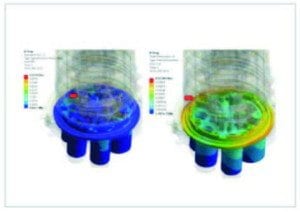
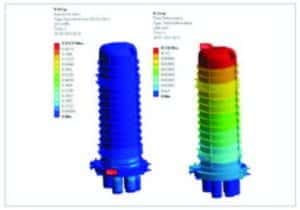
- A 3D assembly model was developed for the fibre optic closure and finite element simulations were performed using impact loading, shock loading and thermal loading conditions as required by the client. The results identified critical stress and deformation regions and were found within permissible limits.
The Challenges:
- 3D modelling accuracy to capture accurate physics during loading conditions
- Ensuring proper application of boundary conditions for number of virtual tests including impact loading, shock loading and thermal loading
- Maintaining accuracy and appropriateness of the FEA results to minimise physical test trials
The client is a manufacturer of various electronics & communication related products and equipment such as cables, sensors, closures etc. Their new design for splice closure needed to be validated virtually under number of loading conditions. The manufacturer as such approached ASTCAD to shorten their development time and seek expert help for virtual simulation testing.
The Solution:
- The software used to perform analysis was ANSYS v14.5 Professional NLS. A 3D Assembly model of Splice Structure was created and analysed for Various Tests: Shock Loading, Impact Loading (Equivalent Static Loading), Temperature Loading etc. The analysis was performed to determine whether the structure will withstand the Tests performed.
Benefits:
- Shortened product development time
- Reduced cost and time required in physical test trials
- Provided opportunity to modify design for future applications
About Australian Design And Drafting Services
ASTCAD Services is a specialist firm providing engineering solutions to organisations across Australia. We have extensive experience in providing concept to manufacturing and post-manufacturing solutions to clients with a team of expert design engineers, CAD professionals and simulation analysts. We are based in Australia, serving with responsive turnaround, with a world-class infrastructure, hardware and software capabilities to address complex engineering problems with least turn around time.
How we approach thermal loading analysis
Thermal loading analysis matters wherever temperature swings drive expansion, stress or performance drift — in this project, fibre optic cable assemblies whose optical performance degrades under thermally induced strain. Our approach models the assembly in FEA with realistic material properties and boundary conditions from the actual service environment, applies the thermal cycles the field will impose, and evaluates the stress and displacement results against the component’s functional limits rather than generic allowables.
Thermal analysis engagements deliver a verification report with model assumptions, load cases, results and design recommendations — often small geometry or material changes that remove a thermal problem entirely. If your product operates across Australian temperature extremes, an analysis pass before field failures is dramatically cheaper than one after.
The fibre optic application here generalises to any temperature-sensitive assembly: enclosures in western-sun exposure, precision mechanisms across day-night cycles, bonded dissimilar materials under seasonal swing. If the failure reports mention cracking, drift or delamination that tracks the weather, thermal loading analysis is usually the diagnostic that explains it.