
Lifting frame FEA and structural certification.
Case study: structural FEA and engineering certification of a 40-tonne lifting frame used for the installation of pre-fabricated concrete panels on a NSW construction site — to AS 1418, AS 3990 and AS 4991.
Project overview
A construction contractor required structural FEA and certification of a custom 40-tonne lifting frame designed to install pre-fabricated concrete wall panels on a high-rise residential project in Sydney. The frame had to handle panels up to 14 m long and provide rotational adjustment during placement.
The challenge
The frame was an evolution of an existing design but with significantly larger panel masses. The original design had no FEA or third-party certification. WorkSafe NSW required full lifting equipment certification to AS 4991 before site use.
Our approach
- Full FEA of frame under static, dynamic and abnormal load cases per AS 4991
- Fatigue analysis based on expected lift cycles
- Connection bolt analysis and slip-critical joint design
- Welding examination plan to AS/NZS 1554.1
- Engineering certification documentation for WorkSafe NSW
Deliverables
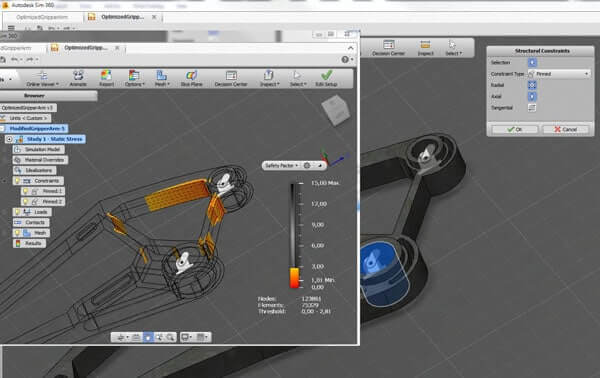
- FEA report with stress contours and safety factors per AS 4991
- Structural calculations and load schedules
- Welding map with NDT requirements
- Operations and maintenance manual
- Engineering certification suitable for site registration
Outcome
The frame was certified and registered for site use within the contractor’s programme. Over 320 panels were installed with no incidents or load failures. The frame remains in service four years later, with quarterly NDT inspections passing without findings.
How we approach lifting frame FEA projects
Lifting frame FEA is verification work, so the analysis has to be defensible. We build the finite element model from the fabrication drawings, apply load cases covering the rated load with dynamic amplification, off-centre lifts and sling angle variations, and check member stresses and weld connections against AS 4100 and the applicable lifting equipment standards. Buckling and deflection are assessed, not just peak stress, and lift point details get local modelling where geometry concentrates load. If the frame fails a check, we iterate the design with the fabricator rather than simply reporting the failure — the goal is a certifiable frame, not a red-contour plot.
FEA reporting and certification support
The deliverable is a verification report documenting geometry, materials, load cases, boundary conditions, mesh convergence, results against acceptance criteria, and a compliance summary an inspecting engineer can rely on. We supply marked-up drawings where modifications are required and updated reports after changes, giving the client a clean documentation trail from design through test lift to service.
When FEA verification is required
Lifting frame FEA sits inside a compliance framework: lifting equipment used on Australian sites requires engineering verification, periodic inspection and documented rated capacity. Verification by analysis suits fabricated frames because it captures the actual geometry and welds, and it pairs with a proof load test to close the loop between model and metal. We advise clients on when analysis alone suffices and when a test lift is warranted, and we structure the report so a certifying engineer or site verifier can trace every acceptance criterion to its standard clause. Frames verified this way move between sites and clients without re-engineering, because the documentation travels with them.
We verify lifting frames, spreader beams and custom lifting equipment for fabricators, hire companies and site engineers Australia-wide. Send us the fabrication drawings and rated load, and we will confirm scope, standard applicability and turnaround before you commit — most single-frame verifications are completed within a week.
This project was delivered as part of our FINITE ELEMENT ANALYSIS – FEA SERVICES. Talk to us about a similar scope.