
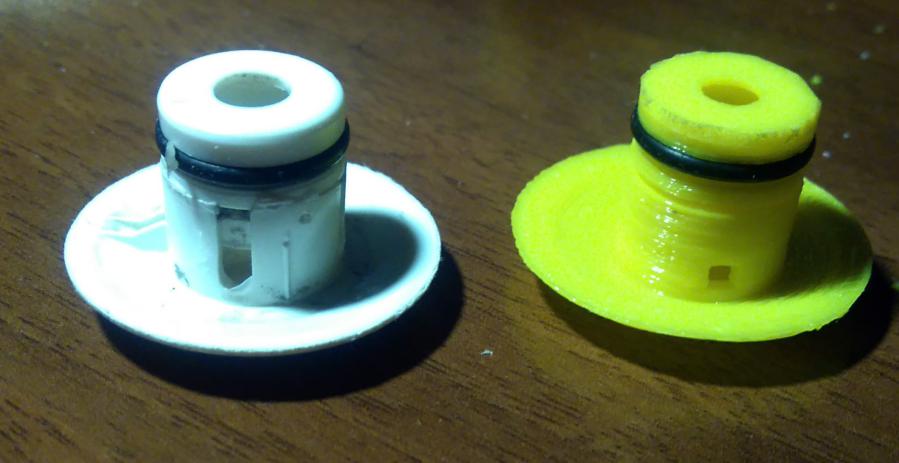
Industrial valve body SLS production part.
Case study: SLS 3D printing of a complex industrial valve body for a Perth-based mining equipment OEM — replacing a multi-part assembly with a single SLS-printed nylon component, eliminating 14 separate machined parts and assembly time.
Project overview
A Perth-based mining equipment OEM engaged ASTCAD to redesign a complex valve body that had previously been a 14-part machined-and-assembled component. The redesigned single-piece SLS nylon part incorporates internal flow channels, integrated mounting features and threaded inserts in a single print operation.
The challenge
The original assembly had 14 machined components with 8 different sealing surfaces — costly to manufacture and prone to leak-path failures. The customer needed equivalent or better performance, equivalent cost, and elimination of the assembly labour without compromising the equipment certification.
Our approach
- Design consolidation — 14 parts to 1 single SLS-printed component
- Internal flow channel design with optimised flow geometry
- Threaded insert integration during print process
- SLS material selection (PA12) for chemical compatibility and strength
- Pressure testing and certification documentation
Deliverables
- Production-validated SLS valve body design
- Manufacturing dossier with print parameters and QC protocol
- Pressure test certification per ISO 5208
- Cost comparison vs. original 14-part assembly
- Field service documentation for replacement units
Outcome
Manufacturing cost reduced by 32% per unit. Assembly labour eliminated entirely. Field reliability data after 18 months in service shows zero leak-path failures across 240 units installed. The customer has migrated four other valve sizes to the same SLS-printed design.
How we approach SLS 3D printing projects
SLS 3D printing suits functional prototypes like this industrial valve body because parts come out of the powder bed strong, isotropic enough for testing, and free of support scars. Our workflow starts with the production-intent CAD, adapts wall thicknesses and features for the SLS process, and nests the build for dimensional stability. For flow components we add test features — gauge ports, fixture bosses — that let the prototype be pressure and flow tested meaningfully, then we strip those features from the production model. Findings from prototype testing are folded back into the casting or machining design before any tooling money is spent.
Prototype-to-production documentation
Deliverables include the SLS-adapted build files with orientation documented, prototype drawings noting deviations from production intent, test fixture designs, and a validation summary comparing prototype test results against the design requirements. The client ends up with a de-risked production design and a documented reason for every change — the difference between a prototype that was interesting and one that paid for itself.
From prototype results to tooling decisions
The value of an SLS 3D printing prototype shows up in the tooling purchase order. For flow components like this industrial valve body, prototype testing typically surfaces port alignment issues, wall thickness opportunities and assembly interferences that would have been discovered in hardened tool steel at fifty times the correction cost. We run a structured review after testing — what passed, what changed, what the production drawing now says — and the client signs off the production design with evidence rather than hope. Tooling quoted from a validated design also comes back tighter, because the toolmaker is not pricing in ambiguity.
We run prototype-to-production programs for flow components, housings and mechanical parts: SLS or FDM prototypes for functional validation, followed by production drawings for casting, moulding or machining. If you are weighing tooling investment against design certainty, a printed prototype round is nearly always the cheaper way to buy confidence.
This project was delivered as part of our 3D Printing Services Australia. Talk to us about a similar scope.