
Lithium battery enclosure production-grade FDM.
Case study: production-grade FDM 3D printing of a 6S lithium battery enclosure for an electric watercraft manufacturer — flame-retardant nylon with integrated cable routing, mounting bosses and seal channels.
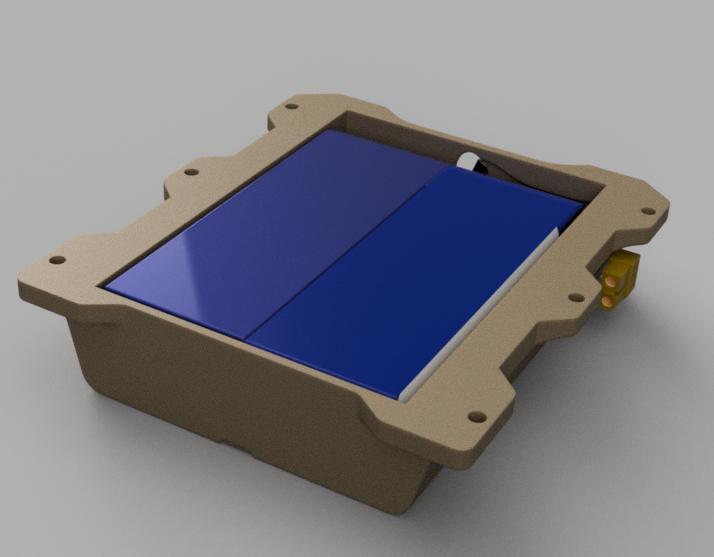
Project overview
ASTCAD designed and printed a production-grade battery enclosure for a Gold Coast-based electric watercraft manufacturer. The enclosure houses a 6S lithium pack with integrated cable routing, mounting bosses for the BMS, and channels for an EPDM gasket seal. The customer required FDM 3D printing for low-volume production (under 200 units annually).
The challenge
Marine applications demand both salt-water resistance and battery-safety compliance. The customer’s volume didn’t justify injection-mould tooling, but the part still had to be production-acceptable — dimensional accuracy, surface finish and material compliance to UL 94 V-0 flame retardancy.
Our approach
- Material selection — flame-retardant nylon meeting UL 94 V-0
- Print orientation analysis for water-tight surfaces and load paths
- Integrated cable channels and snap-fit BMS mounts
- Gasket groove design with appropriate tolerance for EPDM seal
- Post-processing protocol for marine environment
Deliverables
- Production-ready FDM-printed enclosures (200 units annual capability)
- Manufacturing dossier with print parameters
- Quality control protocol with go/no-go gauges
- Material test certificates for UL 94 V-0 compliance
- Design files in STEP and 3MF formats
Outcome
The enclosure entered production in early 2024. The customer reports zero field failures over 180 units shipped. Production cost per unit is approximately 60% lower than the equivalent injection-moulded part at this volume.
How we approach lithium battery enclosure design
A lithium battery enclosure is a safety device that happens to hold cells. Our design process addresses thermal management first — conduction paths, ventilation and separation between cells — then structural retention under vibration and impact, then serviceability. Material selection prioritises flame-retardant rated polymers, and we design venting features that direct any thermal event away from adjacent cells and the user. Cable entries, busbar clearances and creepage distances are dimensioned deliberately, and the enclosure is designed for the production method it will actually use, whether that is 3D printing for low volume or tooling for scale.
Battery enclosure deliverables
The package includes the enclosure CAD model with all internal retention and thermal features, drawings defining critical dimensions and material specifications, DFM notes for the chosen production process, and assembly documentation covering cell installation, torque settings and inspection points. Where the client is pursuing certification, we structure the documentation so the design rationale for thermal and electrical safety decisions is traceable.
Testing and validation approach
Every lithium battery enclosure design we deliver is validated against its failure modes, not just its CAD tolerances. Thermal validation confirms cell temperatures under maximum discharge stay within the chemistry’s limits; vibration and shock assessment covers the transport and service environment; and ingress protection is verified where the enclosure claims a rating. For printed enclosures we test printed specimens, not datasheet values, because as-printed material properties differ from moulded equivalents. The validation summary travels with the design documentation, so when the client scales from printed prototypes to production tooling, the engineering evidence scales with it.
If you are developing a battery-powered product — from portable equipment to stationary storage — we can design the enclosure and integration around your chosen cells and BMS, with the safety engineering documented from the first revision. Early enclosure design prevents the familiar late-project discovery that the cells fit but the thermal budget does not.