We are leading Australian design and drafting companies that provide a wide range of architectural design services at an affordable price. As a global leader in all types of reverse engineering techniques, our project managers having years of experience in rapid prototyping, 3D printing etc., use the best AutoCAD drafting and drawing services. We support manufacturing operations by improving an existing design or deliver insufficient design documentation using modern manufacturing methods.
As one of the best reverse engineering services providers, we help our customers to offer detailed 3D models with improvised design. With an excellent design process, we leverage the latest technologies to deliver top quality services to our clients. Our effective reverse engineering services are not limited to the manufacturing industry and create global clients across various sectors like automotive, consumer electronics, machine tools, medical tools, furniture manufacturing, etc.
Why Choose Our Reverse Engineering Services?
Choosing the right reverse engineering partner is critical to accuracy, efficiency, and cost control. Our services are designed to help manufacturers, designers, and product developers overcome design gaps and production challenges with confidence.
Why clients trust us:
- Australian-based expertise with global delivery capability
- Highly experienced mechanical engineers and CAD professionals
- Proven track record across multiple industries
- Advanced tools and modern manufacturing methods
- Focus on accuracy, precision, and compliance
We don’t just replicate designs—we enhance and optimize them for better performance, manufacturability, and longevity.
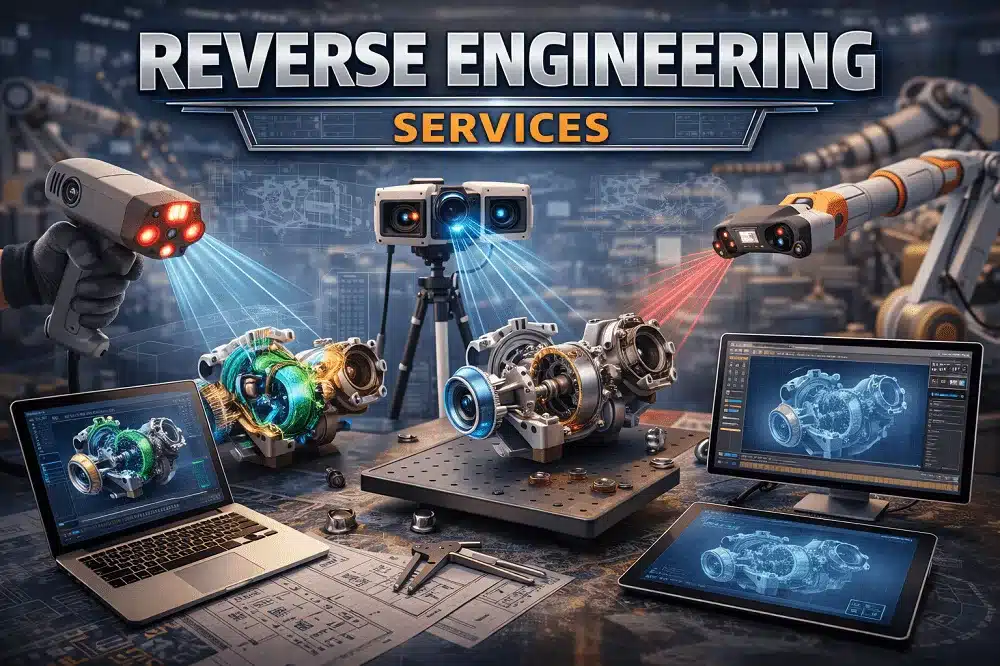
Reverse Engineering Services
Our mechanical engineers have extensive industry experience that includes hands-on product development and other manufacturing experience. Our reverse engineering services play an essential role in the generation and modification of CAD models, especially in 3D CAD services. Our company dealt with customer requirements on a wide scale by taking care of complexity.
With deep expertise in CAD drawing, design and drafting services, we as home designers provide the highest quality engineering design services by demanding various industries’ projects. We carry out work involving class A surfaces as well as electronics intensive consumer products. Our team has worked on castings, forgings, and injection moulded parts that are as small as a couple of millimeters as those that are several feet in dimensions.
Our Capabilities includes:
- Detailed Part Specifications
- Part Scanning
- Benchmarking
- Parametric Modelling
- Hybrid Surface Modelling
- Drawing and Modeling Packages
- Shrink-wrap surface Modelling
- CAI and CAV
Reverse engineering services are a set of processes and techniques used to dissect and analyze a product, device, or system to understand its components, functionality, and design principles. This is typically done to gain insights into how something works, to replicate or modify it, or to troubleshoot and improve its performance. Reverse engineering can be applied to a wide range of industries and fields, including software, electronics, mechanical engineering, and manufacturing. Here are key aspects of reverse engineering services:
- Objectives:
- Understanding: Reverse engineering is often used to gain a deep understanding of a product or system, especially when the original design documentation is unavailable or incomplete.
- Replication: It can be employed to create a duplicate or similar product, which is especially useful when a product needs to be replaced or improved.
- Interoperability: In software and electronics, reverse engineering can help ensure compatibility and integration with existing systems and devices.
- Improvement: Companies may use reverse engineering to identify weaknesses or inefficiencies in a product and then make improvements.
- Techniques and Tools:
- Disassembly: In mechanical engineering and electronics, disassembling the physical product is often the first step. This involves taking it apart to examine its components and construction.
- Software Reverse Engineering: In the context of software, reverse engineering involves decompiling, disassembling, or analyzing code to understand its logic, algorithms, and data structures.
- 3D Scanning: In the case of physical objects, 3D scanning can be used to create a digital model of the object’s shape and structure.
- Reverse Engineering Software: Specialized software tools are used to aid in the analysis and documentation of reverse-engineered data.
- Legal and Ethical Considerations:
- Reverse engineering may involve legal and ethical considerations, especially when dealing with patented or copyrighted products. Laws and regulations regarding reverse engineering vary by country and industry.
- Some forms of reverse engineering are explicitly protected under fair use or specific exemptions in copyright and patent law, especially for interoperability and security testing.
- Applications:
- Software: Reverse engineering is commonly used to analyze and modify software, such as disassembling a program to understand its inner workings or to create compatible software.
- Electronics: It can be applied to understand and modify the functionality of electronic devices, such as circuit boards or integrated circuits.
- Automotive: Reverse engineering is used in the automotive industry to study vehicle components and systems for improvement or repair.
- Manufacturing: Reverse engineering can be used to recreate obsolete or hard-to-find parts and components.
- Benefits and Challenges:
- Benefits: Reverse engineering can provide valuable insights, foster innovation, and help improve products or systems. It is also useful in troubleshooting and maintenance.
- Challenges: It can be time-consuming and costly, especially when dealing with complex systems. Legal issues and ethical considerations may also pose challenges.
- Documentation and Reporting: Reverse engineering often involves detailed documentation and reporting to capture the insights gained during the process. This documentation is valuable for future reference and may be required for legal or compliance purposes.
The technology of Australian Design & Drafting lies in skilled hands. Therefore, we are here to provide solutions in your existing project. Our mechanical engineers have broad industry experience and hold product development & manufacturing experience. They have designed and prototyped complex products. Our efforts include complex automotive castings, investment cast components used in aircraft engines, injection moulded furniture and medical devices. Industries that we have served range from hi-technology, medical, and consumer electronics to machine tools, aerospace and automotive. If you’re seeking a cost-effective and efficient reverse engineering service provider, contact our expert.
Key Features of the Service
Our comprehensive reverse engineering capabilities include:
- Detailed Part Specifications
- High-Accuracy Part Scanning & Digitisation
- Benchmarking & Design Comparison
- Parametric 3D Modelling
- Hybrid Surface Modelling
- Shrink-Wrap Surface Modelling
- Class-A Surface Development
- Drawing & Modelling Packages
- CAI (Computer-Aided Inspection)
- CAV (Computer-Aided Verification)
We work on components ranging from tiny millimetre-scale parts to large industrial assemblies, including castings, forgings, injection-moulded parts, and complex consumer products.
Benefits of Our Reverse Engineering Services
Our reverse engineering services deliver tangible business value:
- Recover Lost or Obsolete Designs
- Improve Existing Product Performance
- Reduce Manufacturing Errors and Costs
- Enhance Design Accuracy and Precision
- Enable Faster Product Development
- Ensure Compatibility with Modern Manufacturing Methods
- Create Editable, Reusable 3D CAD Models
Whether you need to replicate a discontinued part or optimize an existing design, our solutions help you stay competitive.
Our Process / How We Work
Our structured reverse engineering process ensures accuracy and efficiency at every stage:
- Requirement Analysis – Understanding your product, application, and goals
- Physical Inspection & Disassembly – If required, for component-level analysis
- 3D Scanning & Measurement – Capturing precise geometry and dimensions
- CAD Modelling & Surface Development – Creating accurate 3D CAD models
- Design Optimization & Validation – Improving performance and manufacturability
- Documentation & Delivery – Detailed drawings, models, and reports
Each project is handled with strict quality checks to ensure compliance with industry standards.
Reverse Engineering Services for Industries
Our reverse engineering expertise supports a wide range of industries, including:
- Automotive & Transportation
- Aerospace & Aviation Components
- Medical Devices & Tools
- Consumer Electronics
- Machine Tools & Industrial Equipment
- Furniture Manufacturing
- Hi-Technology Products
From automotive castings to aircraft engine components and medical devices, we deliver precision-driven results across sectors.
What CAD Software Do You Use?
We use industry-leading CAD and engineering software to ensure accuracy and compatibility:
- AutoCAD
- SolidWorks
- CATIA
- Creo (Pro/ENGINEER)
- Siemens NX
- Fusion 360
Our software expertise allows seamless integration with your existing workflows and manufacturing systems.
Why We Stand Out (Competitive Advantage)
What makes us one of the best reverse engineering service providers in Australia:
- Deep expertise in CAD design, drafting, and modelling
- Strong focus on precision, tolerances, and quality control
- Experience with complex geometries and Class-A surfaces
- Industry-specific knowledge across manufacturing domains
- Cost-effective solutions with faster turnaround times
Our engineering solutions are built to meet both current and future production needs.
Looking to recreate, improve, or modernize your product design?
Partner with Australia’s trusted Reverse Engineering Services provider.
👉 Contact us today to discuss your project requirements
👉 Get accurate 3D models, detailed CAD drawings, and optimized designs
👉 Turn your existing products into smarter, manufacturable solutions
What is Reverse Engineering?
Reverse engineering is the process of deconstructing a product or component to understand its design, architecture, and functionality. It is commonly used to recreate 3D CAD models from physical objects, improve legacy parts, or analyze competitor products.
When is Reverse Engineering needed?
Reverse engineering is useful in several scenarios:
Legacy parts with no CAD or documentation
Replacing obsolete or discontinued components
Redesigning or improving existing products
Quality control and part validation
Competitive benchmarking
Digital archiving of physical components
What industries benefit from Reverse Engineering Services?
Our reverse engineering solutions cater to industries including automotive, aerospace, consumer electronics, manufacturing, medical devices, heavy machinery, and more.
What tools and technologies do you use?
We utilize advanced 3D scanning, CMM (Coordinate Measuring Machines), laser scanning, CT scanning, and photogrammetry to capture accurate data. CAD software such as SolidWorks, Autodesk Inventor, Creo, and Geomagic Design X is used for modeling.
Can you reverse engineer complex or high-precision parts?
Yes. We specialize in high-accuracy reverse engineering of complex geometries, tight-tolerance components, and assemblies. Our metrology-grade equipment ensures precision and reliability.
What file formats do you provide?
We deliver 3D CAD models in popular formats such as STEP (.stp), IGES (.igs), STL, Parasolid (.x_t), and native CAD formats (e.g., SolidWorks, Inventor). 2D drawings can also be provided in PDF or DXF/DWG formats if needed.